
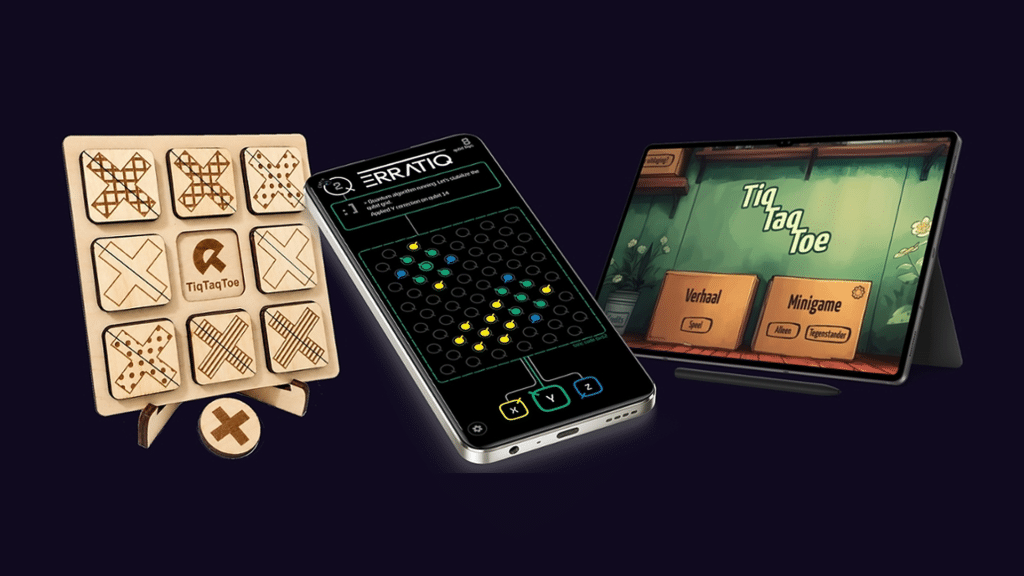
What do games have to do with the quantum computer of the future? More than you might think. The HAIQ-consortium has secured €7.4 million in funding to develop quantum games in which humans and AI work together. The Dutch Games Association is one of the partners.
That role reflects something we aim to do. When research and innovation projects include a serious games component, the Dutch Games Association can join in, bringing the games’ expertise that makes such an application stronger. It is out mission to get Dutch game studios a seat at the table. In HAIQ, that means several studios are helping to build our quantum future!
Quantum needs help
Quantum technology is on the rise and promises computing power far beyond what classical computers can offer. But quantum systems are fragile. They need constant stabilisation, and that task is too complex for humans alone.
Advanced AI will play a crucial role here. The catch: today’s AI systems still lack what you might call “quantum intuition”. The same goes for society as a whole; for most people, quantum is still an abstract and distant subject, in the realm of science fiction.
Why games?
HAIQ bridges the gap with quantum games: these are games in which players and AI work together to fine-tune these quantum systems. The choice to utilize game technologies was made very deliberately. Games are ideally suited to letting people discover something complex by doing it, rather than having it explained to them.
We know from earlier projects that players can reach surprising insights when a scientific challenge is turned into a well-designed game. It gives instant feedback, rewards experimentation and makes an abstract problem tangible. Those are precisely the qualities needed to put human creativity to work on quantum technology.
The gain is twofold. Collaboration between humans and AI accelerates the development of quantum technology. And because anyone can play, society also gains ownership of our quantum future, rather than leaving it to specialists alone.
The role of the DGA
The Dutch Games Association endorses HAIQ’s goals and contributes games expertise where needed. Think of knowledge of game design, of what makes a game genuinely playable and motivating, and of the Dutch games sector itself.
The parties that form a consortium like this often come from very different backgrounds. We know what makes a game playable and engaging, and which studios in the Netherlands can build it. That way, the games side is taken as seriously as the science.
It also shows what games can do. Games are not just entertainment or a form of cultural expression; they are also a powerful tool for tackling societal and scientific challenges.
A broad consortium
What makes HAIQ special is the breadth of the collaboration. Game studios work side by side with leading universities, universities of applied sciences, quantum companies and civil-society organisations:
- Game studios: Game Tailors, Obsessive Science Games, The Barn Games, douwe-sjoerd.nl
- Universities: TU Delft, TU Eindhoven, Leiden University, University of Amsterdam, Vrije Universiteit Amsterdam, Radboud University Nijmegen, Maastricht University, The Hague University of Applied Sciences, Fontys University of Applied Sciences, NHL Stenden University of Applied Sciences, Saxion University of Applied Sciences
- Quantum companies: Groove Quantum, OrangeQS, Qblox, QuLearnLabs
- Networks and institutes: QDNL, NWO Institutes Organisation, SURF, Waag | technology & society, We in Quantum Development (WIQD), Kennisstad Leiden, Key Region Leiden, Dutch Games Association
The project has been awarded €7.4 million, supplemented by €0.05 million in in-kind co-funding.
Games as a bridge to the future
HAIQ shows what the Dutch games sector does best: making complex problems accessible and inviting people to think along by playing. We are proud to be part of it.
Working on a research or innovation project with a serious games component and looking for games expertise in your consortium? Get in touch with the Dutch Games Association. We are happy to help.